HSV-1 and HSV-2 together infect more than 4 billion people. WHO estimates that about 3.8 billion people under 50 carry HSV-1 and roughly 520 million people aged 15 to 49 carry HSV-2. No vaccine or cure has been approved, and none will be approved in 2027.
Research did move in 2026, mostly on the drug side. AiCuris took pritelivir, the first new kind of herpes antiviral in more than 20 years, to the FDA. Gilead picked a once-weekly pill, GS-1179, for a Phase 2 trial.
Vaccines stayed stuck after Moderna and GSK pulled out. Gene editing, the only approach that could remove the virus completely, is still preparing for its first genital herpes trial.
This page explains why herpes is so hard to cure, where each approach stands and what to watch for in 2027. It is based on company announcements, trial registries and published research as of October 2026. For a candidate-by-candidate list of vaccines, see our 2027 herpes vaccine tracker, and for prevalence and cost figures, see our 2027 herpes statistics.
Simplix Viral Defense
Cold Sore & HSV Support
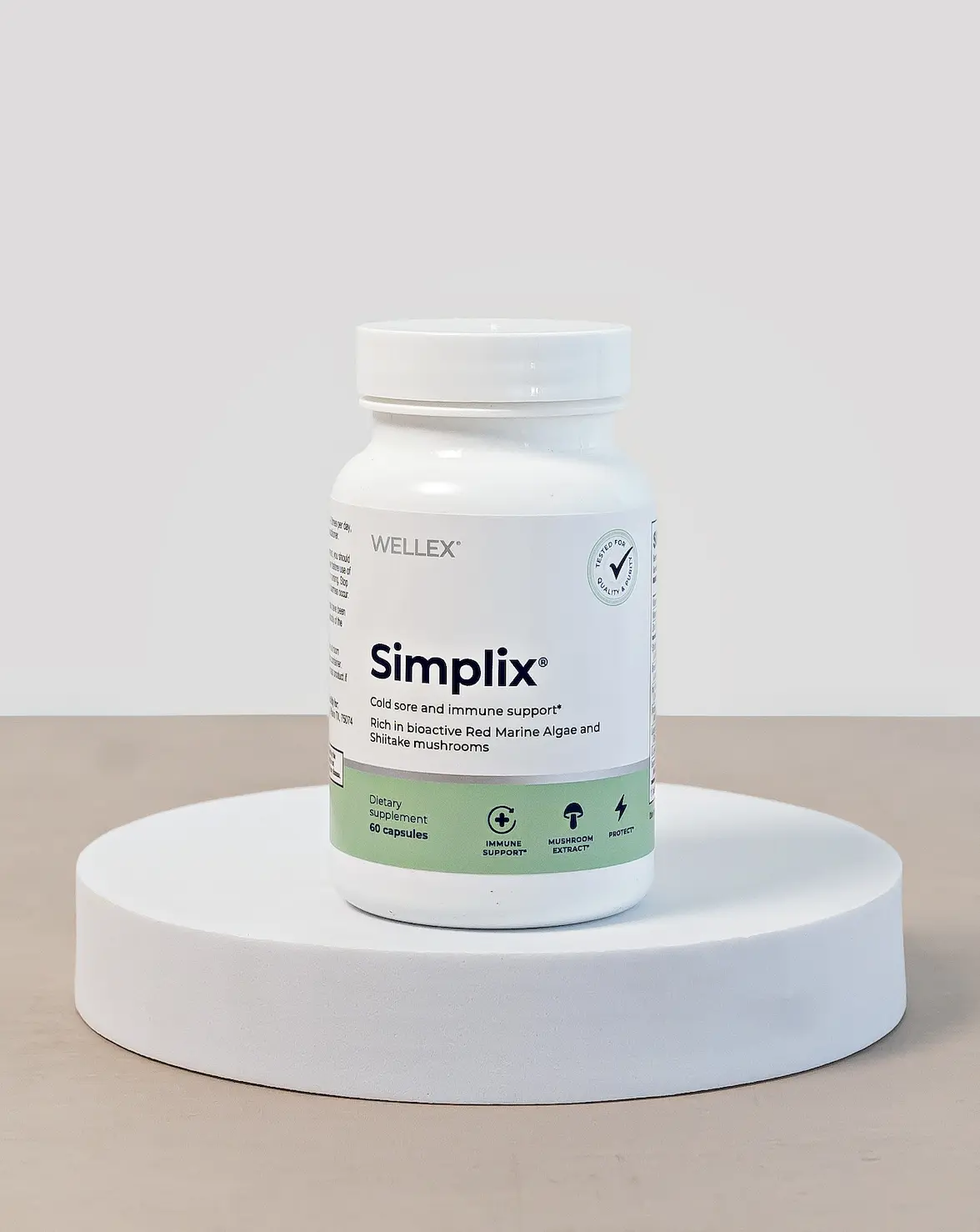
Simplix Viral Defense
Cold Sore & HSV Support
Synergistic formula combining L-Lysine, shiitake mushroom, and marine bioactives for comprehensive immune support.
SHOP NOW & SAVE 15%Herpes is hard to cure because it hides inside nerve cells
After the first infection, HSV travels up nerve fibers and settles in clusters of nerve cells called ganglia. There it goes quiet, a state called latency. The viral DNA sits in the nucleus of the neuron and makes almost no proteins, so the immune system has nothing to target.
Current antivirals such as acyclovir and valacyclovir only work on virus that is actively copying itself. They shorten outbreaks and reduce shedding, but they cannot touch the dormant virus. A cure would need to either destroy that latent DNA or keep it permanently switched off.
We cover the biology in more depth in why there is no cure for herpes.
The virus also fights back against the immune system. HSV reduces the markers on infected cells that T-cells use to spot them, blocks interferon signaling and produces proteins that disable antibodies and complement. That is why a vaccine that only produces antibodies tends to fail.
Past vaccines show how hard this is. GSK's Herpevac, a gD2 protein vaccine, was tested in more than 8,000 women. Published in 2012, it protected about 58% of women against genital disease caused by HSV-1 but had no significant effect against HSV-2. Genocea's GEN-003, a therapeutic vaccine, reduced shedding modestly in Phase 2 but was shelved in 2017 when the company couldn't fund Phase 3.
Each vaccine type has trade-offs. Live-attenuated vaccines produce stronger T-cell and mucosal immunity, but regulators need extensive proof that they are safe for people with weak immune systems. Protein vaccines are very safe but have produced weak T-cell responses. mRNA vaccines sit in between and are the newest approach.
New antivirals made the most progress in 2026
Helicase-primase inhibitors block a viral enzyme that current drugs don't touch. They work against strains resistant to acyclovir and, because some stay in the body for days, they may allow weekly dosing. Two of them moved forward in 2026.
Pritelivir (AiCuris) met its Phase 3 goal in immunocompromised patients whose herpes infections were not healing on standard drugs: 82.4% healed completely, versus 42.0% on other treatments. The FDA gave the application Priority Review in April 2026, and its decision is due by the end of 2026. An approval would make it the first new kind of herpes drug in more than 20 years, but only for this narrow group at first.
Our pritelivir guide explains who it is for and why most people with cold sores or genital herpes won't be prescribed it at launch.
GS-1179 (Gilead, formerly Assembly Bio's ABI-1179) is a once-weekly pill. In a 29-day Phase 1b study in people with recurrent genital herpes, a 50 mg weekly dose cut the share of days with HSV-2 shedding from 16.9% on placebo to 0.4%. Gilead licensed it in December 2025 and in August 2026 chose it to advance into a Phase 2 trial, expected to start by the end of 2026.
In September 2026, after reviewing Gilead's development plan and budget, Assembly Bio opted to pay 40% of US development costs in exchange for a 40% share of US profits. Gilead's plan also includes testing GS-1179 for prevention, possibly alongside HIV pre-exposure prophylaxis (PrEP). More in our weekly herpes pill update.
The sister drug, GS-5366 (formerly ABI-5366), is not moving forward for now. It remains licensed to Gilead, but no development plans have been announced for it.
Amenamevir, another drug in this class, is already approved in Japan for shingles and for recurrent herpes simplex outbreaks. That shows the class can be safe and effective in people.
Vaccine research is down to one large drug company
In September 2024, GSK ended its therapeutic vaccine, GSK3943104, after the Phase 2 trial in people with recurrent genital herpes did not meet its efficacy objective. Our report on the GSK vaccine covers what went wrong.
In November 2025, Moderna announced it would not take its therapeutic mRNA vaccine, mRNA-1608, into Phase 3. This was a budget decision. Interim Phase 1/2 results in about 300 people with recurrent HSV-2 showed no major safety concerns, higher antibody levels and early trends toward fewer recurrences. No other company has announced plans to take it over.
BioNTech's BNT163 is now the only herpes vaccine in clinical trials at a large drug company. It is a preventive mRNA vaccine encoding three HSV-2 proteins (gC, gD and gE), developed with the University of Pennsylvania. Its Phase 1 trial began in December 2022 and is scheduled to finish in October 2026.
So far the trial has found the vaccine well tolerated and able to produce neutralizing antibodies. But Phase 1 does not show whether a vaccine prevents infection. BioNTech has not announced the larger efficacy trial that would.
Rational Vaccines is preparing a Phase 1 trial in the UK of RVx201, a live-attenuated HSV-2 vaccine, and began collecting volunteer details in February 2026. Sanofi's HSV529, a replication-defective vaccine, was discontinued in 2022. Other weakened strains, such as ΔgD-2 and gD27, have protected animals in lab studies but are not in human trials.
Our 2027 vaccine tracker covers each of these candidates in detail.
Gene editing is the only approach aiming to remove the virus
Gene editing tries to cut the dormant viral DNA inside neurons so it can never reactivate. If it worked in people, it would be the first real cure. So far, all of the evidence comes from lab studies or from eye infections, which are much easier to reach than nerve ganglia.
At Fred Hutchinson Cancer Center, Dr. Keith Jerome's team uses meganucleases, enzymes that cut specific DNA sequences, delivered by adeno-associated virus (AAV). In a 2024 lab study in mice, a single-vector version that cuts the viral DNA in two places removed about 90% of latent HSV-1 after oral infection and 97% after genital infection. It also caused fewer side effects on the liver and nerves than earlier versions.
The team has said it hopes to start human trials around 2026 or 2027. No trial has been registered on ClinicalTrials.gov.
In China, BDgene's BD111 uses CRISPR delivered in virus-like particles to target HSV-1 in the cornea, where it causes herpetic stromal keratitis, a leading infectious cause of blindness. Early human results were published in 2023. A 40-patient Phase 2a trial (NCT06474442) compares BD111 plus standard treatment with standard treatment alone.
That trial's primary completion date is December 2026 and its final completion date is March 2027, so results could appear in 2027. More in our BD111 report.
Excision BioTherapeutics' EBT-104 uses CRISPR to cut two genes HSV-1 needs to survive. In lab studies in rabbits with latent eye infection, it stopped viral shedding in 92% of treated eyes. It has not entered human trials.
The main hurdles are delivering the editor to every infected ganglion, avoiding cuts in human DNA and proving long-term safety in nerve tissue. Our CRISPR and herpes explainer covers how these tools work.
Approval takes years even when a trial succeeds
A preventive herpes vaccine needs a Phase 3 trial with thousands of participants followed for one to two years, because researchers have to wait for enough new infections to compare groups. Recruiting, following and analyzing such a trial takes two to four years.
A therapeutic vaccine or a new antiviral can use smaller trials, since outbreaks and viral shedding can be measured in people who are already infected. That is one reason drugs are moving faster than preventive vaccines.
After a successful Phase 3, standard FDA review takes about 10 to 12 months, or 6 to 8 months with Priority Review. Manufacturing scale-up and supply add more time.
For a sense of scale, HPV vaccines took about 15 years from discovery to approval, and GSK's shingles vaccine Shingrix took about two decades. mRNA COVID-19 vaccines were fast because of unprecedented funding, a global emergency and huge numbers of infections during trials. None of those conditions applies to herpes.
Several things could shorten the wait, and others could stretch it
The FDA has several programs that speed up promising treatments. Pritelivir used most of them, receiving Fast Track, Breakthrough Therapy and Priority Review designations.
A herpes vaccine or drug could move faster if:
- Phase 2 shows a large, clear reduction in outbreaks or shedding
- a bigger company or public funder takes on an abandoned candidate such as mRNA-1608
- regulators accept viral shedding as a surrogate endpoint, which would allow smaller and shorter trials
- a long-acting antiviral such as GS-1179 proves it can prevent infection, not only treat it
- combination approaches, such as a vaccine plus a long-acting antiviral, show added benefit
Timelines get longer if:
- Phase 2 results are modest and the trial has to be redesigned
- unexpected safety signals appear, especially for live-attenuated vaccines or gene editing
- companies cut funding, as Moderna did
- trials struggle to recruit and keep participants over long follow-up periods
Results due in 2027 will show which programs are on track
Several events in late 2026 and 2027 will show whether the timeline below holds:
- Pritelivir's FDA decision and launch. The final label, the price and how quickly transplant and cancer centers can get it will decide how many patients it reaches.
- GS-1179's Phase 2 trial. A ClinicalTrials.gov listing will show its size, its length and whether it compares the weekly pill with daily valacyclovir.
- BNT163's final Phase 1 results. The bigger question is whether BioNTech announces an efficacy trial.
- BD111's Phase 2a results. These would be the first controlled data on gene editing against a herpes virus in people.
- A first gene editing trial for oral or genital herpes. A registered trial or FDA clearance for the Fred Hutch approach would be the biggest step toward a cure so far.
- RVx201 dosing. Rational Vaccines has not yet started giving the vaccine to volunteers in the UK.
We will update this page as each of these happens. If none of them moves, every date below slips.
A realistic timeline puts new options around 2030
Based on where each program stands now:
- Pritelivir: FDA decision due at the end of 2026, for drug-resistant herpes in immunocompromised patients only
- Once-weekly pill (GS-1179): Phase 2 during 2027, possible approval around 2030 or later
- Preventive vaccine (BNT163): no efficacy trial announced, approval unlikely before 2030 to 2032
- Gene editing for oral and genital herpes: first human trials in 2027 at the earliest, approval likely well into the 2030s
Many people with herpes have seen "cure by next year" headlines for decades. The candidates above are real, but each still has to pass trials that have stopped earlier efforts.
In the meantime, existing tools work. Daily suppressive antivirals cut outbreaks by 70% to 80% and reduce transmission to partners. Condoms, avoiding sex during outbreaks and telling partners lower the risk further.
Outbreaks also tend to become less frequent over the years, as our guide to whether herpes goes away explains. Many people also manage triggers with sleep, stress control and natural approaches to managing outbreaks.
Herpes Cure 2027 FAQs
Is there a cure for herpes in 2027?
No. No treatment removes the latent virus from nerve cells. Gene editing is the only approach aiming for that, and it has not yet entered oral or genital herpes trials.
Will there be a herpes vaccine in 2027?
No. The most advanced active vaccine, BioNTech's BNT163, has only been through Phase 1. A licensed vaccine is unlikely before 2030.
What new herpes treatment is coming soonest?
Pritelivir, which has an FDA decision due by the end of 2026. It is meant for immunocompromised patients whose herpes no longer responds to standard drugs, not for everyday cold sores or genital herpes.
When will the weekly herpes pill be available?
Not before about 2030. Gilead's GS-1179 is entering Phase 2, and a Phase 3 trial would have to follow before approval.
Why did Moderna stop its herpes vaccine?
Moderna cited budget priorities in November 2025. Its Phase 1/2 data showed no major safety problems and early signs of benefit.
Is gene editing for herpes being tested in people?
Only for eye infections so far. BDgene's BD111 is in a Phase 2a trial in China for HSV-1 keratitis. No gene editing trial for oral or genital herpes has started.
How can I take part in herpes cure research?
Search ClinicalTrials.gov for "herpes simplex" and filter by "Recruiting" and your location. Trials for people with recurrent genital herpes are the most common.

Image: Bravado Labs L-Lysine Cold Sore Treatment
Bravado Labs L-Lysine Cold Sore Treatment
Why we love it:
- Verified Customer Favorite
- High Quality Ingredients
As an affiliate, we earn from qualifying purchases.